

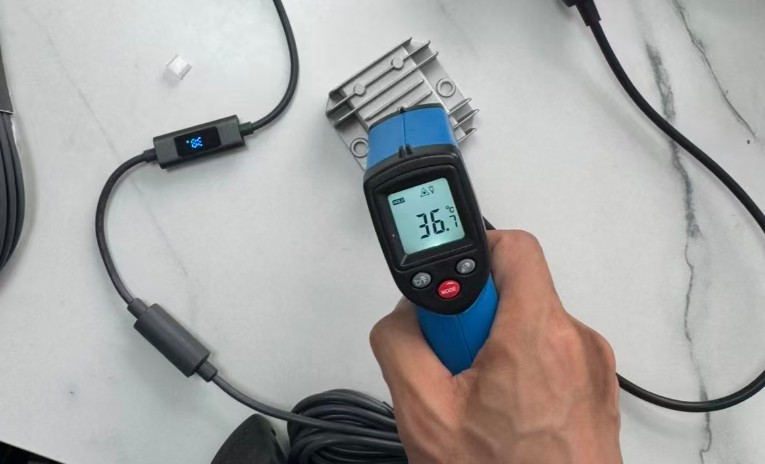
Our upgraded 12V to 38V DC-DC car power supply is built for RV, off-road vehicles, boats and mobile Starlink users. It delivers stable 38V DC to run Starlink dish without heavy heat buildup, solving the common overheating issue of conventional step-up chargers during long-hour operation.
Working Principle & Our Thermal Solutions
We cannot eliminate heat 100% (power conversion always has minor loss), but we drastically reduce heat generation and maximize heat dissipation, to keep the unit running cool under continuous load.
- High-Efficiency Synchronous Rectification Circuit (Cut Heat At Source) Traditional boost converters use ordinary diodes, which create large power loss and heat. We adopt synchronous MOSFET rectification instead. It greatly reduces conduction loss during switching, raises conversion efficiency up to 94%+. Less energy wasted → less heat generated at the very beginning.
- Optimized High-Current Inductor Design Custom low-loss magnetic core + thick copper winding inductor. Lower copper resistance and magnetic core hysteresis loss. It handles the large 12V-side input current with minimal heat from the inductor, which is one of the biggest heat sources in standard 12V boost chargers.
- Full Aluminum Alloy Housing as Integrated Heat Sink The metal casing is not just a shell. PCB power components are tightly bonded to the aluminum housing via high thermal-conductivity thermal pads. Internal heat transfers rapidly out to the large surface of the metal shell, spreading heat evenly into the surrounding air. No hot-spot concentration.
- Reasonable Power Derating & Component Selection We over-rate all power semiconductors (MOSFETs) with sufficient current margin. Components work within a mild operating range instead of running at their limit. This avoids extra heat caused by stressed, overloaded chips, especially during Starlink’s peak power events (boot-up, snow melting heater activation).
- Internal Airflow & Structural Layout Optimization PCB layout separates high-power heat-generating components from sensitive small chips. Heat sources are distributed, not clustered in one tiny area. The casing has reserved ventilation gaps to support natural convection, letting hot air escape passively. No fan required, zero fan noise and no fan failure risk.
- Smart Thermal Protection as Backup Safety Layer Built-in temperature sensing circuit. If the ambient temperature is extremely high or airflow is blocked, the unit will trigger soft power reduction (not abrupt shutdown) to control temperature, protecting both the charger and your Starlink terminal. It resumes full power once cooled.
Short Marketing Summary (for product page)
Heat cannot be fully eliminated in DC-DC conversion, but we tackle overheating from two directions: ✅ Raise conversion efficiency to reduce heat generation ✅ Deploy full aluminum heat sink structure to accelerate heat dissipation Our 12V-38V Starlink car charger maintains a low operating temperature even under continuous full load, ideal for long-time mobile Starlink use in RVs, trucks and off-road vehicles.