

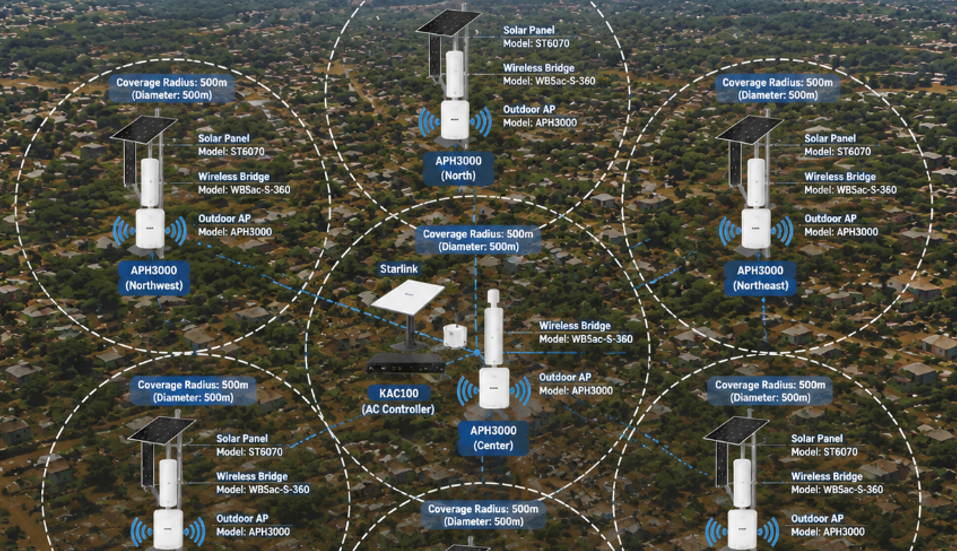
A family-run eco-lodge sits at 1,800 m in a valley with no fiber, no usable mobile signal, and a ridge blocking line of sight to the nearest town. Guests expected reliable Wi-Fi for video calls and payments. The brief: connectivity for 12 detached cabins and the reception building, with minimal trenching.
1. The problem
- No terrestrial broadband; the only realistic backhaul was satellite.
- The reception desk had a clear sky view for Starlink, but the cabins were behind a wooded slope.
- Trenching CAT6 between cabins was rejected as too disruptive to the landscape.
2. The solution
A Starlink Mini was mounted on the reception roof on a pole. From there, a pair of 25 km 5.8 G wireless bridges formed a point-to-point link across the valley to a relay mast near the cabins — the 5.8 G band was chosen to avoid the crowded 2.4 G band used by guest phones. At the relay, two outdoor WiFi6 Mesh APs (IP67, PoE) covered the cabin cluster. Everything outdoor is PoE, so each node needs only one CAT5e drop.
| Role | Gear |
|---|---|
| Backhaul | Starlink Mini + 144W 48V adapter (PL72-V3V4) |
| Valley link | 25 km 5.8G bridge pair (high-power, PoE) |
| Cabin Wi-Fi | Outdoor WiFi6 Mesh AP ×2 (IP67, 24 dBm) |
3. Results
After alignment, the bridge sustained a stable link and the lodge measured ~80 Mbps down at reception and 40–60 Mbps at the furthest cabin. Power was drawn from the lodge's 24 V solar bank through a step-down to the bridge's PoE injector. Uptime through a winter storm held because every outdoor joint used IP67 glands and the antennas were mounted below the ridge wind load.
4. Lessons
When you cannot trench, a high-power 5.8G bridge + outdoor mesh APs is cheaper and faster than Starlink at every cabin. Put one dish where the sky is clear, then beam connectivity over the obstacle.